
Botox for Frown Lines: What to Expect
Botox for Frown Lines: What to Expect
By Total Med Solutions Editorial Team · Updated 2026-08-03
Botox injections relax the muscles causing glabellar lines, the vertical creases between the brows targeted by this FDA-approved treatment. Total Med Solutions administers Botox under physician supervision at DFW locations including Allen, Plano, Flower Mound, Hurst, Dallas, Fort Worth and Southlake. Results typically appear within days, smoothing frown lines while preserving natural facial expression and movement.
Key Takeaways
Botulinum toxin injection represents the most frequently performed cosmetic procedure in the United States today.
Botox temporarily prevents wrinkles by freezing muscles that control facial expressions like frowning.
Frown lines and crow’s feet are the two cosmetic indications officially approved for treatment.
Patients can treat frown lines alone without requiring forehead injections during the same session.
Botulinum toxin injection represents the most frequently performed cosmetic procedure in the United States today.
Botox temporarily prevents wrinkles by freezing muscles that control facial expressions like frowning.
Frown lines and crow’s feet are the two cosmetic indications officially approved for treatment.
Patients can treat frown lines alone without requiring forehead injections during the same session.
What Causes Frown Lines and How Does Botox Help?
Vertical lines between the brows develop from two forces working together: thinning skin and years of repeated muscle movement. Dermal atrophy — the gradual loss of collagen and skin thickness — combines with constant contraction of the muscles between the eyebrows every time a client frowns, squints, or concentrates. Over time, that repetitive motion carves a crease into skin that no longer bounces back the way it once did.
Botox addresses this at the source rather than just the surface. The treatment works by blocking the release of acetylcholine, a chemical messenger nerves use to signal muscles to contract, at the neuromuscular junction. Once that signal stops, the targeted muscle relaxes, and the skin above it smooths out gradually over the following days.
Is Botox Actually Approved for Frown Lines?
Yes. Frown lines and crow’s feet rank among the cosmetic uses officially approved by the FDA for botulinum toxin treatment. Clinical experience shows predictable outcomes, few adverse effects, and consistently high patient satisfaction, which is part of why the treatment remains a trusted option for first-timers.
What About Alternatives Like Dysport?
Clients exploring cosmetic injectables beyond Botox often ask about Dysport, another botulinum toxin option. Dysport targets moderate to severe frown lines specifically, softening that area without altering the rest of the face’s natural expression.
What Happens During Treatment and Recovery?
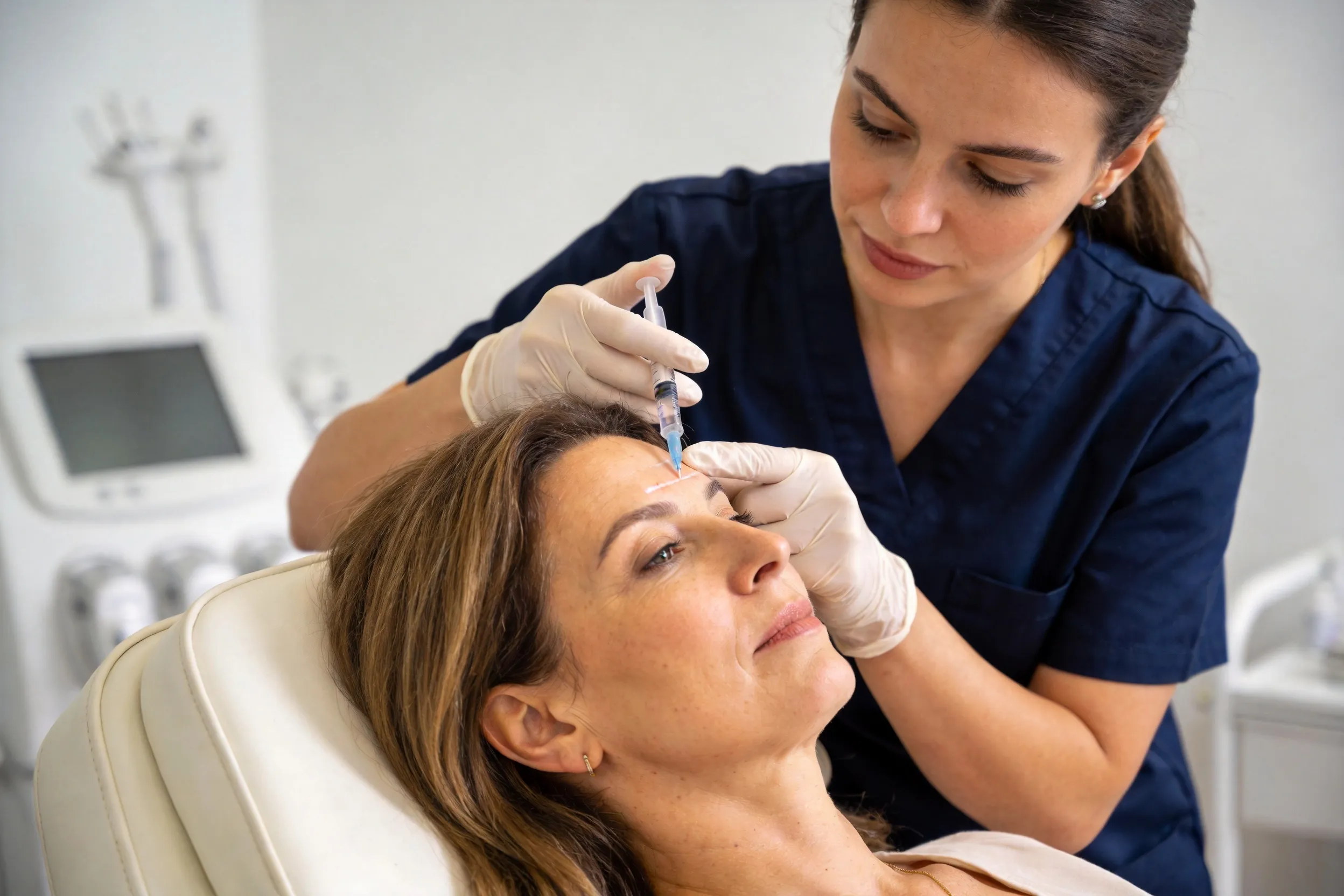
Treatment for glabellar lines takes only a few minutes, with a series of small injections placed directly into the muscles between the brows. A thin needle delivers botox or a similar neuromodulator to the targeted area. The rest of the face stays completely unaffected. Untreated muscles keep working normally. Patients can still raise their eyebrows, smile, and show natural expressions everywhere else on the face. cite-1
No downtime follows a typical session. Most patients return to work or errands immediately. Mild redness or small bumps at the injection sites usually fade within an hour.
How soon will results show up?
Change can appear within 24 hours of treatment, according to data on cosmetic injectables like Dysport. Most patients notice visible smoothing between days two and three, with full results settling in over the following week.
Will the results look natural or “frozen”?
Clinical satisfaction data shows a notable share of users describe their results as natural-looking rather than stiff. Ninety-five percent of patients report satisfaction with just two treatments per year, making upkeep simple. At the Fort Worth location, botox is offered alongside other injectables, weight loss support, and vitamin hydration therapy for a more complete approach to wellness.
Should You Treat Frown Lines Alone or the Whole Face?
Frown lines alone can absolutely be treated without touching the forehead. Board-certified physicians confirm that patients decide, together with their provider, whether a targeted approach or a broader plan fits their face and their budget. Nothing about botox requires an all-or-nothing commitment.
That flexibility matters most for first-timers who feel nervous about looking “frozen.” Treating only the vertical lines between the brows keeps forehead movement natural while still softening the crease that tends to age a face the fastest. Results are well documented: in clinical studies, 26.1% and 20.3% of adults saw a two-grade improvement in frown line severity by day 30, evidence that a focused treatment can deliver visible change without expanding into other areas.
Is it safe to skip the forehead and crow’s feet?
Yes. Physicians routinely treat frown lines in isolation when a patient’s main concern is that single area. Skipping other zones does not compromise safety or reduce the effectiveness of the frown-line treatment itself.
A consultation remains the deciding factor. Total Med Solutions offers personalized cosmetic injectable planning across eight DFW locations. Including Plano, Allen, Dallas, Southlake, and Fort Worth. So patients can map out a plan built around their goals, not a one-size-fits-all package.
FAQ
Is Botox FDA-approved for treating frown lines?
Yes, frown lines and crow’s feet rank among the cosmetic uses officially approved by the FDA for botulinum toxin treatment, with predictable outcomes and few adverse effects.
How long does it take to see results from Botox for frown lines?
Change appears within 24 hours, with most patients noticing visible smoothing between days two and three, and full results settling in over the following week.
Will Botox make my face look frozen or unnatural?
No, clinical satisfaction data shows a notable share of users describe their results as natural-looking rather than stiff, and untreated muscles continue working normally for natural expressions.